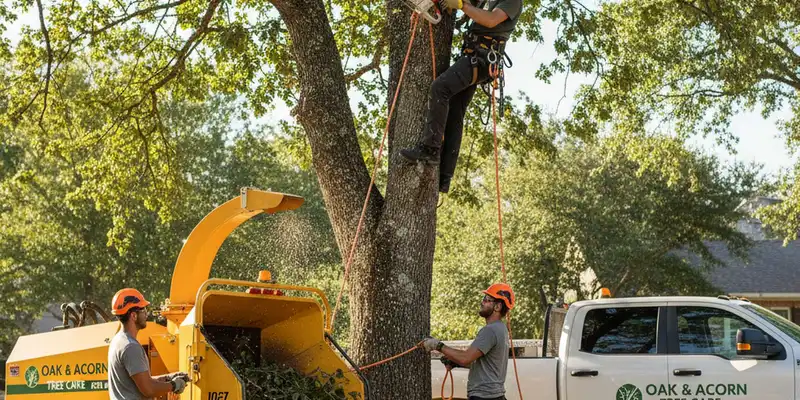
Lexington, OK sits along the South Canadian River corridor, where rural homes, working acreage, and newer neighborhoods exist under a thick canopy of post oak, eastern red cedar, and cottonwood. Properties in this area often deal with tight access on unpaved county roads, unstable soils near flood-prone ground, and ongoing fungal pressure tied to seasonal moisture. The network of tree care professionals in Shawnee knows how to evaluate the risk in mature trees, open up canopy clearance around buildings and fence lines, and protect roots in clay-heavy ground that can stay wet well into spring.
That is a big reason more Lexington, OK property owners rely on Arbor Tree Care to keep their landscapes in good shape throughout the year.

Prefer to Talk to An Expert?
(405) 395-4383
Why Lexington Property Owners Trust Local Professionals to Get It Right
Because they work in this area every day, these professionals understand the river-bottom soils, seasonal storm pressure, and dense canopy conditions that shape tree care in Lexington. Each job is handled with the right tools and methods for local properties, including flood-plain access limits, oak wilt concerns, and wind-throw risk common in this part of Shawnee.
From expert stump removal solutions near the low-water crossings along State Highway 39 to canopy thinning on large acreage parcels east of Main Street, every project is completed with care, precision, and long-term property function in mind.
If you care about keeping your land safe and orderly, local contractors can help maintain a landscape that stays stable, healthy, and accessible.
Our Tree-Service Services
in Shawnee, OK, Include
A Service Area Designed to Fit Your Lexington Neighborhood
Wide lots and unpaved road access mean Lexington tree work needs a tailored approach, not a generic one. That is why local professionals adjust their methods to match the rural and semi-rural features found throughout the area.
It makes no difference whether the property is a riverfront acreage in the South Canadian bottoms, a newer home in the Lexington Heights area, or a working farmstead near the intersection of State Highway 74 and County Road 1210.
From professional tree trimming services and tree pruning to stump removal and emergency tree services, every service is shaped around Lexington’s rural character and the specific conditions of each property.

Lexington's Mature Canopy, Rooted in History
Lexington is one of the older communities along the South Canadian River, with settlement patterns that trace back to the Land Run era and a landscape shaped by decades of farming and river-corridor growth. That history still shows up in legacy timber stands, aging fence-line trees, and erosion-prone embankments that influence how tree care has to be done here today.
Flood-Plain Soil Instability and Root Exposure
Many Lexington properties, especially low-lying tracts near the South Canadian River and the county road corridors south of town, sit on sandy loam and alluvial soils that can shift after heavy rain. That movement can expose roots and weaken support, creating serious lean risk for large cottonwood and willow trees that have been left to grow for decades.
Local professionals address that instability with targeted reliable root protection services, soil stabilization assessments, and strategic canopy reduction to help prevent long-term failure and access problems along property lines.
Oak Wilt and Fungal Disease Pressure
The area’s dense post oak and blackjack oak populations provide valuable canopy cover, but they can also carry steady disease pressure. Oak wilt can move through connected root systems and lead to rapid crown decline and the loss of multiple trees.
Professionals respond with targeted quality tree disease treatment solutions, pruning wound sealant applications, and infected material removal, all adjusted to the clay and sandy loam soils common around Lexington.
Aging Fence-Line and Windbreak Timber
After years of agricultural use, many Lexington fence-line cedars and hedge apple trees need regular attention to stay structurally sound.
Trusted pros manage these areas through selective thinning, deadwood removal, and canopy balancing, which helps windbreaks work more effectively while lowering the chance of storm-damaged limbs falling onto livestock areas or equipment storage buildings.
Severe Storm and Wind-Throw Risk
Spring and summer storms in Oklahoma can bring straight-line winds, hail, and occasional tornado activity, all of which can cause broken limbs, uprooted trees, and blocked access on rural Lexington properties.
Experienced crews use aerial lift equipment, coordinated ground crews, and debris removal methods to restore access and stabilize the site, even after the kind of severe weather this region sees regularly.
Limited Equipment Access on County Roads
Narrow county roads and unpaved rural lanes are common around Lexington, which makes staging large equipment and working safely in the canopy more difficult than on a typical residential street.
Local pros rely on compact aerial units and tracked ground equipment, while also protecting the property and access routes, so tree services can be completed across a wide range of rural and semi-rural site layouts.
For ideas on keeping your Lexington property maintained year-round, request a free quote from a local professional in Lexington by calling (405) 395-4383.
Every property deserves safe access. Let Arbor Tree Care help you maintain it!

Begin your tree service project today
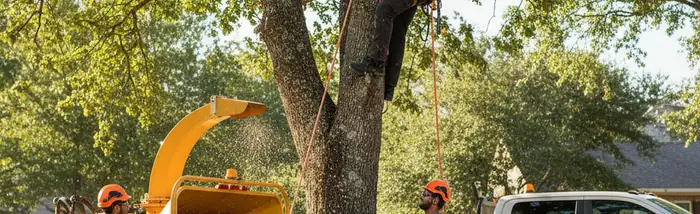
Tree Services in Lexington, OK: Care for Every Season
From routine trimming to emergency storm cleanup, local pros help keep properties safe, healthy, and accessible in every season:
Routine Tree Trimming and Pruning in Lexington, OK
- Canopy thinning on large rural lots — Reducing wind resistance in mature post oak and cottonwood stands along the South Canadian River corridor to help lower the chance of storm-related limb failure.
- Clearance trimming over outbuildings — Managing branch overhang above barns, equipment sheds, and covered livestock areas often found on agricultural parcels east of Main Street.
- Fence-line pruning — Cutting back cedar and hedge apple growth along boundaries to keep fence access open and reduce the chance of livestock getting tangled.
- Crown lifting on roadside trees — Raising branch clearance along County Road corridors where low limbs can create visibility issues and height hazards for farm equipment and service vehicles.
- Structural pruning for younger plantings — Correcting co-dominant leaders and weak branch unions in newly planted shade trees in Lexington’s newer subdivisions, similar to the approach used for tree trimming services in Tecumseh, OK where suburban and rural lot types meet.
Schedule trimming and pruning before Oklahoma’s spring storm window opens to reduce risk across your Lexington property.
Tree Removal Services in Lexington, OK
- Hazardous tree removal near structures — Safely removing leaning or root-compromised cottonwood and willow trees that could threaten homes, outbuildings, and fence lines on flood-plain properties.
- Storm-damaged tree removal — Clearing split trunks, uprooted root balls, and hanging limb sections left behind after severe weather along the State Highway 39 and Highway 74 corridors.
- Dead tree removal in agricultural areas — Taking down standing dead timber in fence rows and windbreaks where decay has progressed enough to create collapse risk.
- Multi-stem cedar removal — Removing eastern red cedar clusters that spread into pasture land and compete with native canopy species across rural Lexington properties.
- Coordinated removal on tight access lots — Handling full tree removal on parcels with limited road frontage using compact rigging systems, a method also used by professionals working on tree removal contractors in Purcell, OK where access constraints are similar.
Removing hazardous and dead trees before storm season helps reduce property damage and keeps rural access routes open all year.
Stump Grinding and Cleanup in Lexington, OK
- Stump grinding in pasture areas — Removing below-grade stump material in open pasture and hay field sections where leftover roots can create mowing hazards and equipment damage.
- Fence-line stump removal — Clearing old hedge apple and cedar stumps along property lines to make room for fence post installation and line upkeep.
- Post-removal site cleanup — Chipping and hauling woody debris left from large canopy removal projects on rural acreage throughout the Lexington area.
- Root flare grinding — Addressing surface roots that have lifted or cracked concrete pads, equipment aprons, and gravel driveways on older residential and agricultural properties.
- Stump treatment for regrowth prevention — Applying cut-surface treatments to persistent species like eastern red cedar and Osage orange that can resprout from remaining roots after removal.
Complete stump grinding removes tripping hazards, limits regrowth from aggressive native species, and restores usable ground across Lexington’s rural and residential lots.
Emergency Tree Services in Lexington, OK
- Storm response and fallen tree removal — Quick deployment for uprooted or split trees blocking driveways, county roads, and access routes after severe weather in the Lexington area.
- Hanging limb and widow-maker extraction — Safely removing broken limbs suspended in the canopy after high winds, when waiting creates a serious hazard for anyone working below.
- Structure impact assessment and clearing — Checking and removing tree sections that have contacted roofs, outbuildings, or utility lines during storm events.
- After-hours emergency dispatch — Providing response outside normal business hours when blocked access or structural contact cannot wait for a scheduled appointment.
- Post-storm debris management — Collecting and removing scattered woody debris from large rural lots where storm activity has spread branches across pasture and yard space.
Fast emergency response helps limit secondary damage, restores safe access, and addresses contact risks before conditions get worse on Lexington properties.